The pantry · Commis
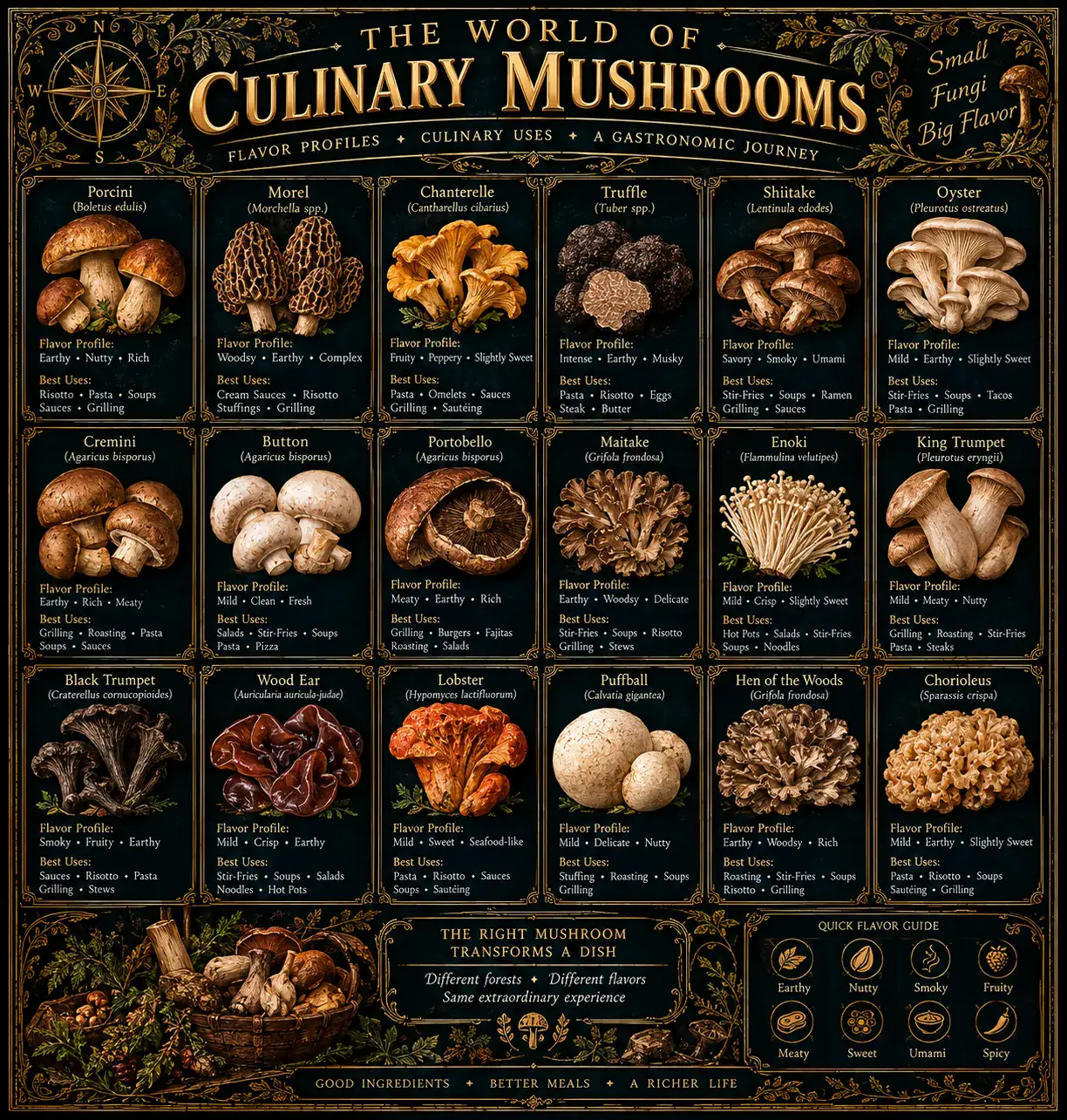
The World of Culinary Mushrooms
Flavor profiles, culinary uses, a gastronomic journey.
18 on the plate · read, never graded
What the plate gets wrong
The picture was generated, and these are its errors of fact, checked against the kitchen and the Lexicon. Read the plate with them.
- Enoki prints “Flammulina velutipes”. The cultivated enoki sold in shops is Flammulina filiformis, split in 2018 from the European velvet shank Flammulina velutipes, a close cousin rather than the same mushroom. The app's Lexicon entry for Enoki opens with Flammulina filiformis and names the 2018 split from the European velvet shank.
- Wood Ear prints “Auricularia auricula-judae”. Most dried black wood ear a kitchen buys is Auricularia heimuer, named in 2014 and long sold under the name of the European jelly ear, Auricularia auricula-judae, and cloud ear is Auricularia cornea. The app's Lexicon entry for Wood Ear teaches that the Chinese dried product is Auricularia heimuer and that Auricularia auricula-judae is the elder European jelly ear.
- Lobster prints “Illustrated as an orange cluster of tiered, fan shaped shelves”. A lobster mushroom is a single lumpy, distorted red orange body with white flesh, because Hypomyces lactifluorum is a mold that grows over a Russula or Lactarius and deforms it, so the drawing shows a bracket fungus such as chicken of the woods, not a lobster mushroom. The panel draws tiered orange fans, which is the form of chicken of the woods (Laetiporus), and a cook would learn the wrong shape to recognize at the market.
- Hen of the Woods prints “Hen of the Woods (Grifola frondosa): earthy, woodsy, rich”. Hen of the woods and maitake are one mushroom, Grifola frondosa, so this panel repeats the Maitake panel under a second name and should be read as the same entry. Both panels print the identical Latin name Grifola frondosa, and the app's Lexicon entry for Maitake opens with Grifola frondosa, hen of the woods, yet the plate gives the one mushroom two flavor profiles (delicate in one panel, rich in the other).
- Cauliflower prints “Chorioleus (Sparassis crispa)”. The mushroom with the Latin name Sparassis crispa is the cauliflower mushroom, and Chorioleus is not a real mushroom name. Sparassis crispa is sold and foraged everywhere as the cauliflower mushroom, its ruffled pale cluster is what the panel draws, and no genus, species or trade name called Chorioleus exists.
On the plate
The mushrooms
- Porcini Latin Boletus edulisFlavor Earthy, nutty, richBest uses Risotto, pasta, soups, sauces, grilling The card The Lexicon
- Morel Latin Morchella spp.Flavor Woodsy, earthy, complexBest uses Cream sauces, risotto, stuffings, grilling The card The Lexicon
- Chanterelle Latin Cantharellus cibariusFlavor Fruity, peppery, slightly sweetBest uses Pasta, omelets, sauces, grilling, sautéing The card The Lexicon
- Truffle Latin Tuber spp.Flavor Intense, earthy, muskyBest uses Pasta, risotto, eggs, steak, butter The card
- Shiitake Latin Lentinula edodesFlavor Savory, smoky, umamiBest uses Stir-fries, soups, ramen, grilling, sauces The card The Lexicon
- Oyster Latin Pleurotus ostreatusFlavor Mild, earthy, slightly sweetBest uses Stir-fries, soups, tacos, pasta, grilling
- Cremini Latin Agaricus bisporusFlavor Earthy, rich, meatyBest uses Grilling, roasting, pasta, soups, sauces The card The Lexicon
- Button Latin Agaricus bisporusFlavor Mild, clean, freshBest uses Salads, stir-fries, soups, pasta, pizza
- Portobello Latin Agaricus bisporusFlavor Meaty, earthy, richBest uses Grilling, burgers, fajitas, roasting, salads The Lexicon
- Maitake Latin Grifola frondosaFlavor Earthy, woodsy, delicateBest uses Stir-fries, soups, risotto, grilling, stews The card The Lexicon
- Enoki Latin Flammulina velutipesFlavor Mild, crisp, slightly sweetBest uses Hot pots, salads, stir-fries, soups, noodles The card The Lexicon
- King Trumpet Latin Pleurotus eryngiiFlavor Mild, meaty, nuttyBest uses Grilling, roasting, stir-fries, pasta, steaks The card
- Black Trumpet Latin Craterellus cornucopioidesFlavor Smoky, fruity, earthyBest uses Sauces, risotto, pasta, grilling, stews The card The Lexicon
- Wood Ear Latin Auricularia auricula-judaeFlavor Mild, crisp, earthyBest uses Stir-fries, soups, salads, noodles, hot pots The Lexicon
- Lobster Latin Hypomyces lactifluorumFlavor Mild, sweet, seafood-likeBest uses Pasta, risotto, sauces, soups, sautéing
- Puffball Latin Calvatia giganteaFlavor Mild, delicate, nuttyBest uses Stuffing, roasting, soups, grilling
- Hen of the Woods Latin Grifola frondosaFlavor Earthy, woodsy, richBest uses Roasting, stir-fries, soups, risotto, grilling The card
- Cauliflower printed “Chorioleus” Latin Sparassis crispaFlavor Mild, earthy, slightly sweetBest uses Pasta, risotto, soups, sautéing, grilling
Also on the plate
Quick flavor guide
- Earthy, Nutty, Smoky, Fruity
- Meaty, Sweet, Umami, Spicy
Quiz yourself
Up to 8 questions drawn from the plate, answers and all. Nothing is recorded: the plate is a reference, and the deck and the Lexicon are where a word is graded.
Printed around the edge: Flavor profiles, culinary uses, a gastronomic journey. · Small fungi, big flavor · The right mushroom transforms a dish. Different forests, different flavors. Same extraordinary experience. · Good ingredients, better meals, a richer life