The larder by region · Chef de Partie
Northwest Fruits
Local harvests, seasonal flavors, timeless traditions.
25 on the plate · read, never graded
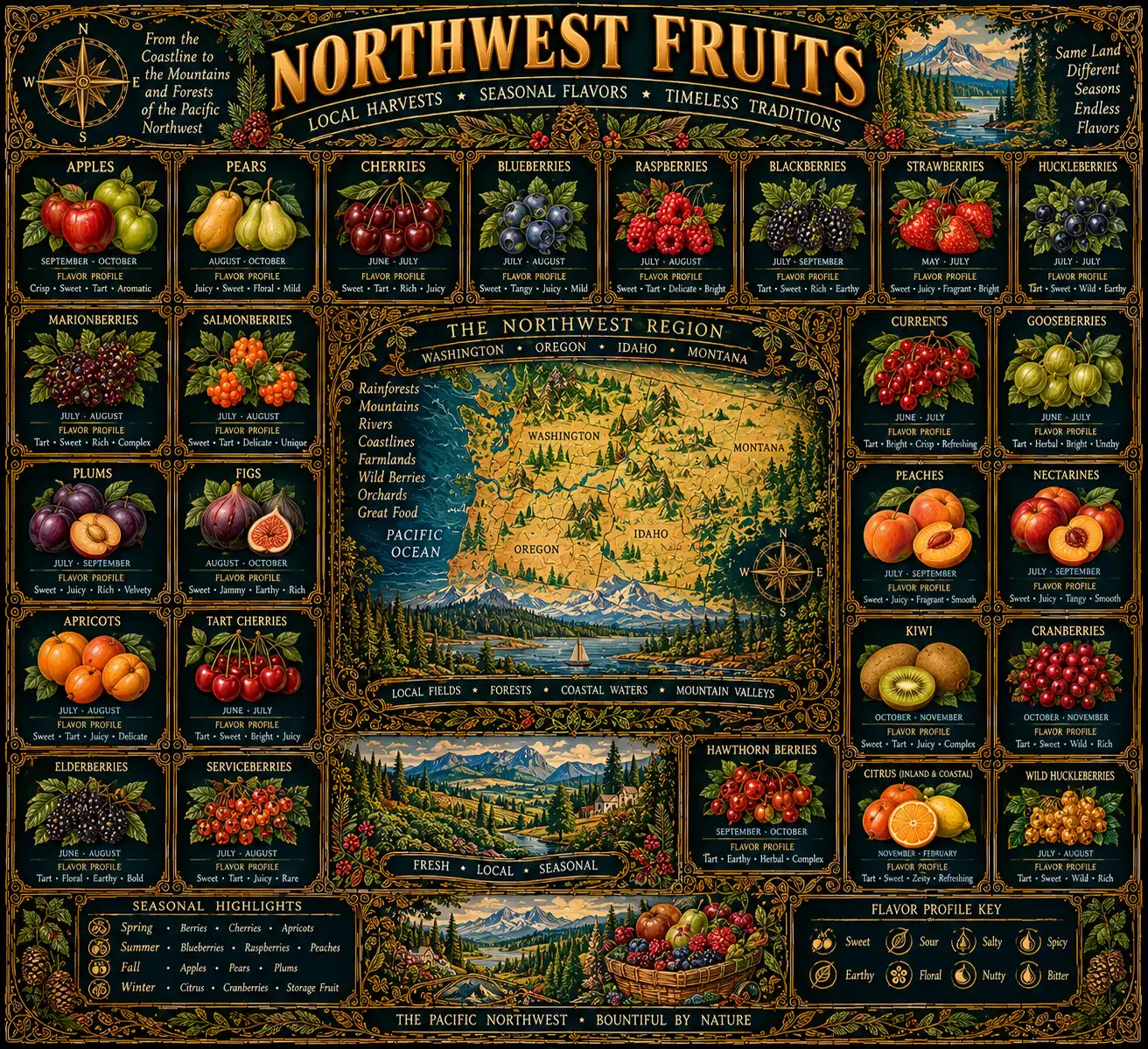
What the plate gets wrong
The picture was generated, and these are its errors of fact, checked against the kitchen and the Lexicon. Read the plate with them.
- Huckleberries prints “JULY - JULY”. Mountain huckleberries ripen from mid July through September, climbing with elevation and peaking in August, so the season reads July to September. A season that begins and ends in the same month is a misprint, and the plate's own Wild Huckleberries card prints July to August for the same fruit.
- Salmonberries prints “JULY - AUGUST”. Salmonberries are the first wild berry of the Northwest year, ripening from late May through June and finishing in early July on the coast, so the season reads May to July. Rubus spectabilis fruits weeks ahead of the raspberries and blackberries the plate correctly places in July and August, and the bushes are picked bare by the time the plate says the season begins.
- Currants prints “CURRENTS”. The fruit is spelled currants; a current is a flow of water or electricity. The card draws red currants on their strigs, and the app's Fruit Atlas carries Redcurrant and Blackcurrant entries under that spelling.
- Gooseberries prints “Tart, Herbal, Bright, Unthy”. The fourth flavor word is earthy; the printed Unthy is a garbled word and not a flavor. Unthy is not an English word, and earthy is the only term from the plate's own flavor set that fits the letter shapes and the pattern of the other cards.
- Elderberries prints “JUNE - AUGUST”. Blue and black elderberries in the Northwest ripen from late August into September, so the season reads August to September; June is when the plant flowers, not when it fruits. The card draws dark black elderberries, which are a late summer and early fall fruit, and the only elderberry ripe in June is the red elderberry, which cooks avoid.
- Serviceberries prints “illustration of red-orange clustered berries”. Ripe serviceberries, also called saskatoons, are dark purple blue with a dusty bloom and look like blueberries; the red-orange clusters drawn on the card look like mountain ash and should not be used to identify the fruit. Amelanchier alnifolia ripens through red to a deep purple blue and is picked only at that stage, so a forager or server matching the picture would pick the wrong shrub.
- Citrus prints “CITRUS (INLAND & COASTAL), NOVEMBER - FEBRUARY”. Citrus is not a Northwest crop; the oranges, lemons and grapefruit on a Northwest menu are shipped in from California, Arizona, Texas, Florida or Mexico, and no inland or coastal citrus belt exists in Washington, Oregon, Idaho or Montana. Citrus trees do not survive the winter freezes of any of the four states on the plate's map, and the only Northwest citrus is a few container grown Meyer lemons, which is not a harvest.
- Wild Huckleberries prints “WILD HUCKLEBERRIES, JULY - AUGUST”. This is the same fruit as the Huckleberries card on the top row, and the plate carries one fruit under two names; every huckleberry sold in the Northwest is wild picked, since the plant has never been farmed commercially, so there is no farmed crop to set a wild one against. Vaccinium membranaceum and its relatives resist cultivation, both cards carry the same tart, sweet, wild flavor words, and the two cards print overlapping seasons.
- Wild Huckleberries prints “illustration of golden-orange clustered berries”. Huckleberries are dark purple, blue black or red and never golden orange; the drawing looks closer to sea buckthorn or cloudberries and should not be used to identify huckleberries. The Huckleberries card on the top row shows the correct dark blue black berries, and no huckleberry species ripens yellow or orange.
- Seasonal highlights prints “Spring: Berries, Cherries, Apricots”. Spring in the Northwest yields rhubarb, the first strawberries and salmonberries; cherries start in mid June and apricots not until July, so both belong under summer. The plate's own cards print Cherries as June to July and Apricots as July to August, and the Northwest is a late region where nothing tree ripened is picked before June.
- Seasonal highlights prints “Winter: Citrus, Cranberries, Storage Fruit”. Winter in the Northwest means storage fruit such as apples, pears and kiwi plus frozen or dried berries; citrus is shipped in from other states and cranberries are a fall harvest, picked October to November on the Washington and Oregon coast. The plate's own Cranberries card prints October to November, and citrus does not grow in the region at all.
On the plate
The fruits
- Apples Season September to OctoberFlavor Crisp, sweet, tart, aromatic The Lexicon
- Pears Season August to OctoberFlavor Juicy, sweet, floral, mild The Lexicon
- Cherries Season June to JulyFlavor Sweet, tart, rich, juicy
- Blueberries Season July to AugustFlavor Sweet, tangy, juicy, mild The Lexicon
- Raspberries Season July to AugustFlavor Sweet, tart, delicate, bright The Lexicon
- Blackberries Season July to SeptemberFlavor Tart, sweet, rich, earthy The Lexicon
- Strawberries Season May to JulyFlavor Sweet, juicy, fragrant, bright The Lexicon
- Huckleberries Season July to JulyFlavor Tart, sweet, wild, earthy The Lexicon
- Marionberries Season July to AugustFlavor Tart, sweet, rich, complex
- Salmonberries Season July to AugustFlavor Sweet, tart, delicate, unique
- Currants printed “Currents” Season June to JulyFlavor Tart, bright, crisp, refreshing
- Gooseberries Season June to JulyFlavor Tart, herbal, bright, earthy The Lexicon
- Plums Season July to SeptemberFlavor Sweet, juicy, rich, velvety The Lexicon
- Figs Season August to OctoberFlavor Sweet, jammy, earthy, rich
- Peaches Season July to SeptemberFlavor Sweet, juicy, fragrant, smooth The Lexicon
- Nectarines Season July to SeptemberFlavor Sweet, juicy, tangy, smooth The Lexicon
- Apricots Season July to AugustFlavor Sweet, tart, juicy, delicate The Lexicon
- Tart Cherries Season June to JulyFlavor Tart, sweet, bright, juicy
- Kiwi Season October to NovemberFlavor Sweet, tart, juicy, complex The Lexicon
- Cranberries Season October to NovemberFlavor Tart, sweet, wild, rich The Lexicon
- Elderberries Season June to AugustFlavor Tart, floral, earthy, bold The Lexicon
- Serviceberries Season July to AugustFlavor Sweet, tart, juicy, rare
- Hawthorn Berries Season September to OctoberFlavor Tart, earthy, herbal, complex
- Citrus(Inland & Coastal) Season November to FebruaryFlavor Tart, sweet, zesty, refreshing
- Wild Huckleberries Season July to AugustFlavor Tart, sweet, wild, rich
Also on the plate
The region
- Rainforests
- Mountains
- Rivers
- Coastlines
- Farmlands
- Wild berries
- Orchards
- Great food
States on the map
- Washington, Oregon, Idaho, Montana
- Pacific Ocean
Seasonal highlights
- Spring: Berries, Cherries, Apricots
- Summer: Blueberries, Raspberries, Peaches
- Fall: Apples, Pears, Plums
- Winter: Citrus, Cranberries, Storage Fruit
Flavor profile key
- Sweet, Sour, Salty, Spicy
- Earthy, Floral, Nutty, Bitter
Quiz yourself
Up to 8 questions drawn from the plate, answers and all. Nothing is recorded: the plate is a reference, and the deck and the Lexicon are where a word is graded.
Printed around the edge: Local harvests, seasonal flavors, timeless traditions. · From the coastline to the mountains and forests of the Pacific Northwest. · Same land, different seasons, endless flavors. · Local fields, forests, coastal waters, mountain valleys. · Fresh, local, seasonal. · Washington, Oregon, Idaho, Montana · The Pacific Northwest, bountiful by nature.